
Super Bori Sunday: Culture, Crisis, and the Political Direction that We Need
This past February 8th, on Super Bowl Sunday in Seattle, Washington, the Puerto Rican Independence Party (PIP), alongside other organizations in the Puerto Rican diaspora, came together for what we called the Super Bori Sunday to celebrate the fact that one of our nation’s children—Bad Bunny, Or Benito Antonio Martinez Ocasio—was playing at the halftime show. It was a collective effort that included groups such as Floriboris (Central Florida), Philly Boricuas (Philadelphia), Victory for Puerto Rico (New York), and the Puerto Rican Independence Party (Seattle). In each of these spaces, we brought leaders of the Puerto Rican diaspora together to celebrate our nation’s feats in the face of exploitation and repression and to think seriously about what this moment meant for the Puerto Rican nation and our struggle for national liberation. As a colony of the US, Puerto Rico is undergoing an economic crisis that was induced by its extractive economic relationship with the US, along with the exclusive political institutions that uphold this relationship. While there were a variety of activities dubbed “Benito Bowls” that were happening that same evening across the US, the goal of our events was to center Bad Bunny’s music, to situate it in the broader cultural upheaval happening among Puerto Ricans across the archipelago and the diaspora, and to connect that energy to a growing and ever more palpable independence movement.
In several public appearances that I’ve made while doing organizing work for the Puerto Rican Independence Party, I’ve often referred to this moment as a cultural renaissance where Puerto Ricans are finding new ways to (re)connect with their nation through art, music, and a renewed interest in the history of our collective struggles. When thinking about moments analogous to the ones that Puerto Rico is experiencing, it’s not uncommon to see periods of deep economic and political crisis give rise to creative explosions. Puerto Rico, as a colony facing crippling austerity measures, waves of displacement, colonial corruption schemes, and patterns of hyperexploitation, is living precisely such a moment. Bad Bunny’s music—in its open reference of the ills of colonialism and various forms of consequential inequality, coupled with a renewed sentiment of our nation’s dignity in the face of these ills—is often seen as a source of the strength for our nation’s resistance to imperialism. However, it’s also important to note that these expressions of cultural power also emerge from a place of political powerlessness. Bad Bunny, as my good friend Cesar Perez Lizasuain once mentioned, is the “cantante de la crisis” or the “singer of the crisis” and embodies in a sense an outlet that may also work as an escape valve for social pressures. In this same vein, while our nation’s symbols can inspire different forms of resistance against imperialism, it can also pacify resistance in its ability to allow people to feel connected to a struggle, without really having to take on the burden of organizing. It’s what is often referred to in Puerto Rico as ‘cultural nationalism’—a term used pejoratively to refer to shallow and politically inconsequential expressions of Puerto Rican nationhood.
Without getting into the weeds of what every public commentator and intellectual has made about this concept (cultural nationalism), we recognize that if we don’t guide expressions of our nationhood in the direction of change, we won’t ever achieve it. Our expressions of nationhood through widely consented upon cultural references—such as what is expressed in Bad Bunny’s music—are not enough to catalyze change for our nation’s freedom. Puerto Rico needs political direction to carry out our eventual decolonization, and the diaspora—often thought of as sleeping giant among independentistas—must learn to push its weight around and demand and end to US imperial rule.
Much of the work behind this event was carried by Iván Ramos, our communications secretary, who took on the lion’s share of the organizing. And, luckily for us, that sleeping giant in Seattle happened to host one of the teams that played in the Super Bowl: The Seattle Seahawks.
We held the event at a space once called the Liberation Center in Chinatown with community partners. The evening opened with introductions by me, in my role as vice president of the party in the diaspora, and by Sarah Silva, a social worker, community leader, bomba dancer, and singer. This was followed by an educational presentation led by Alejandro Tañon, our party’s youth representative in the Diaspora, and Heather (Heat) Camacho, a local community organizer in Seattle. We then shifted to a Bad Bunny lyrics trivia game led by Alejandro and Heat, that was interrupted by a surprise call by Juan Dalmau—the Secretary General of the Puerto Rican Independence Party.
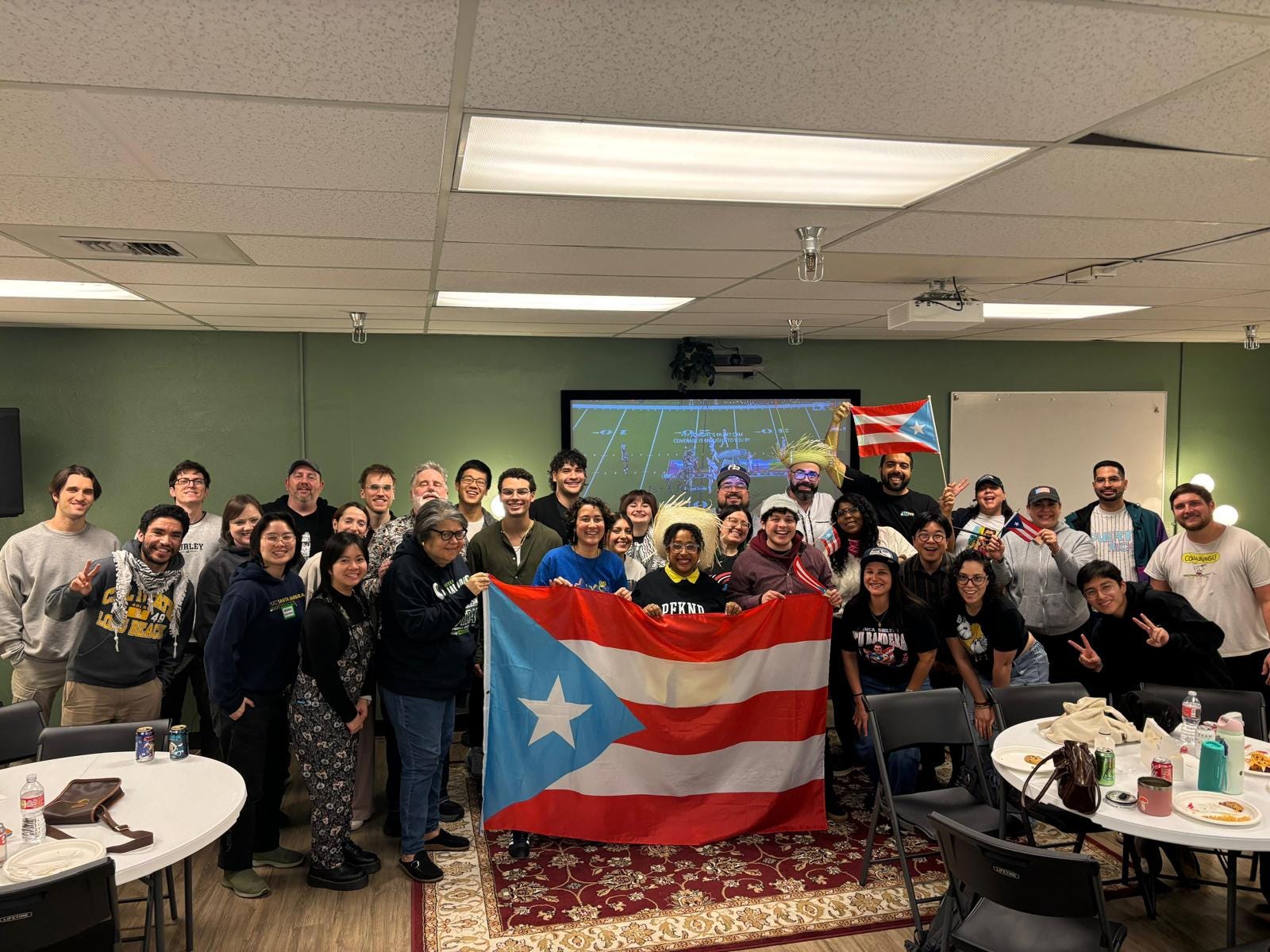
Following these events, we all watched the game together, as we awaited the halftime show.
After the Seahawks won, our group poured out into the streets with Puerto Rican flags. We marched up and down downtown Seattle until we reached Pioneer Square. There, we formed a circle and began to sing and dance. Some songs were Christmas parranda chants, others were Bad Bunny tracks, and still others were political slogans for independence. But what I loved most was how dozens of people joined in—Puerto Ricans, other Latinx folk, and even many USians—who felt drawn to what they were witnessing.
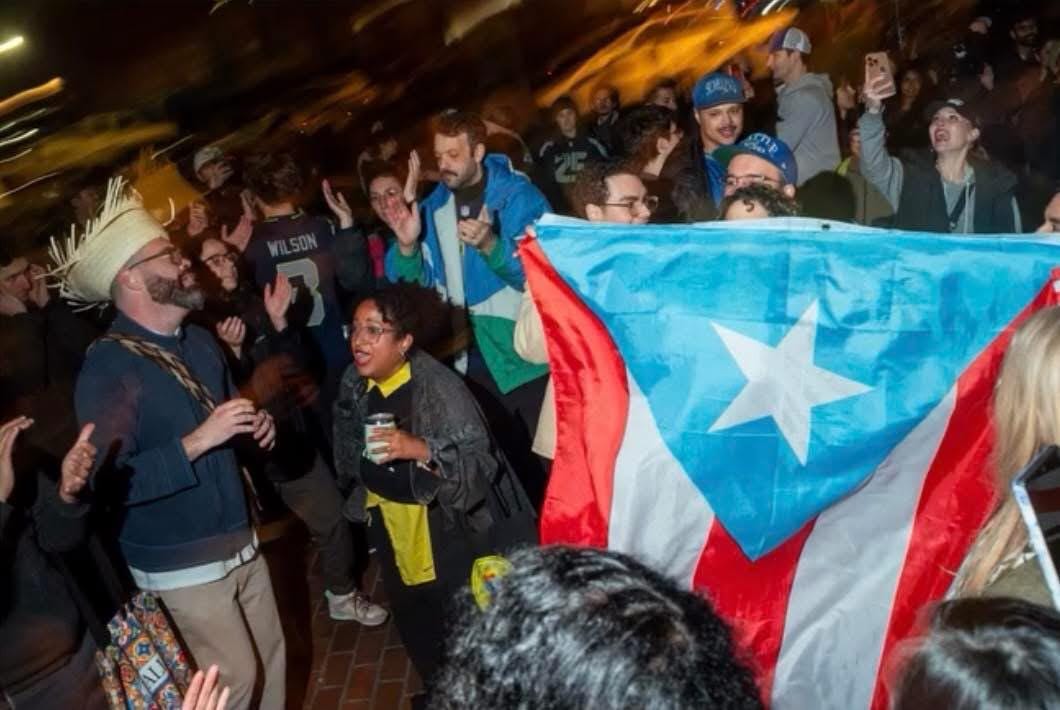
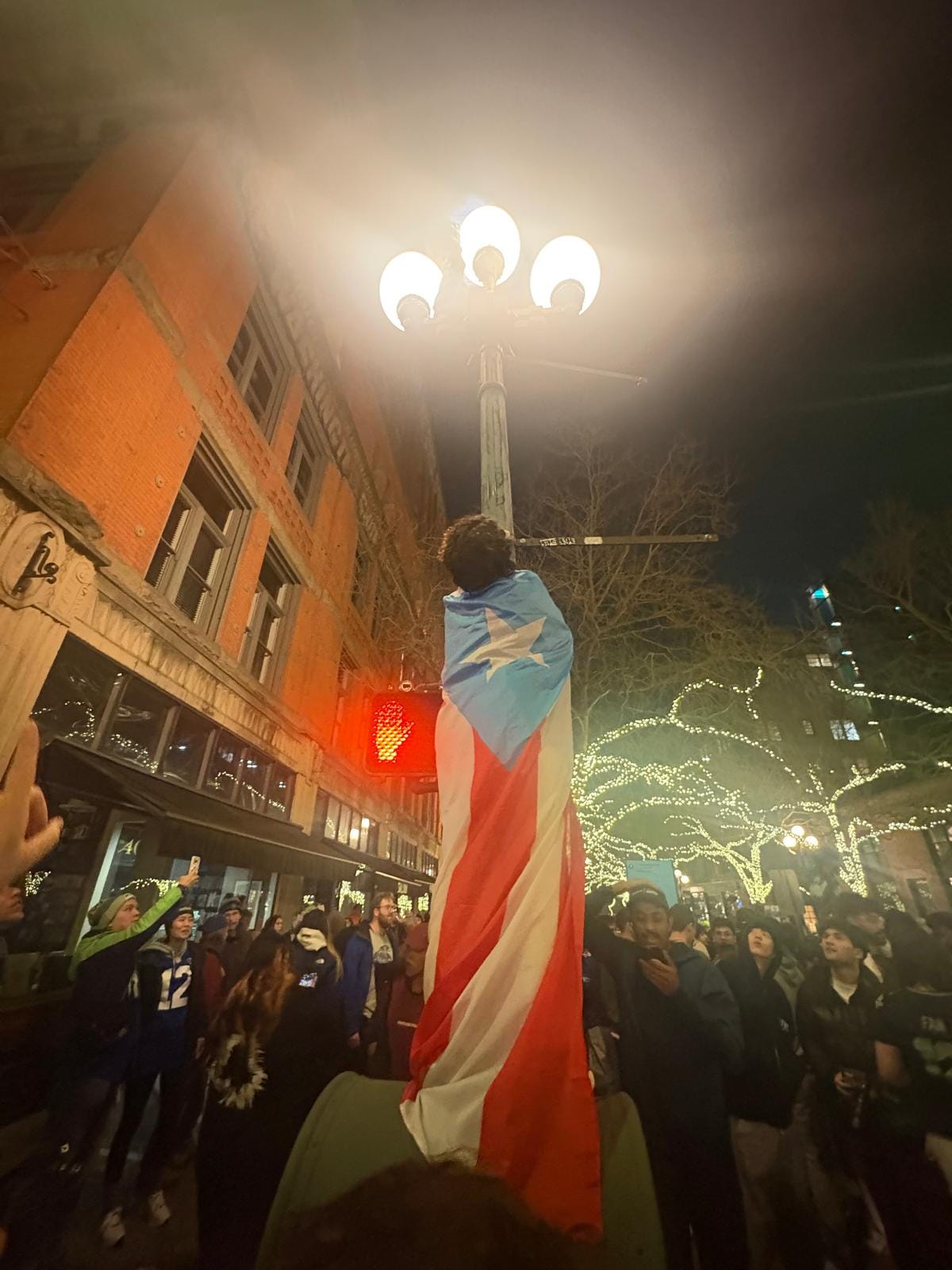
For me, what made the moment special was how differently we celebrated. While much of the city’s celebration involved rowdiness—people climbing light posts, hitting signs, throwing things—we created an alternative space: a dance circle where everyone was invited to participate in a jovial, loud, celebratory, yet peaceful manner. It became something genuinely magical.
That moment captured something essential about our idea of nationhood. Our vision of the Puerto Rican nation is not one that invades others, flattens differences into exploitable situations, competes to assert its dominance over others, or seeks to exclude anyone from the benefits of being part of the Puerto Rican nation. Our understanding of nationhood—as Dr. Pedro Albizu Campos reminded us—belongs to anyone willing to affirm (and fight for) our struggles. That vision stands in sharp contrast to some people who move to Puerto Rico—such as crypto-bros, tax haven seekers, and corporate freeloaders—not to build with us, but to extract from us. It represents an ethos that is foreign to many USians; one that was palpable in its ability to allure the casual onlooker and bring them into the beauty and dignity that is the Puerto Rican nation.
Colonial mentalities that occupy the minds of many Puerto Ricans compel them to think of themselves as weak, and by extension, incapable of helping forge our nation’s destiny outside of the exploitive domain of empire. While far from a national liberation struggle in and of itself, Super Bori Sunday reminds us of our capabilities and our strengths. We are not only capable of achieving great feats—such as independence—we are capable of being a beacon of freedom, dignity, and solidarity for anyone that would wish to assert our nationhood as we walk towards collective forms of liberation.
Moving forward, the diaspora must continue to organize intentionally in the direction of liberation and catalyze these moments by being present to guide them. If we want our freedom and are willing to organize for it here in the belly of empire, it’s only a matter of time until we achieve it.
For more information about what Puerto Rico’s struggle for Independence, visit our site: Independent Puerto Rico: The World Awaits! Let's Build a Sovereign Nation.
Loved the article, very well written! Just followed and looking forward to more of your writing.
Outstanding! I could feel the spirit of whole experience! Que viva Puerto Rico Libre!